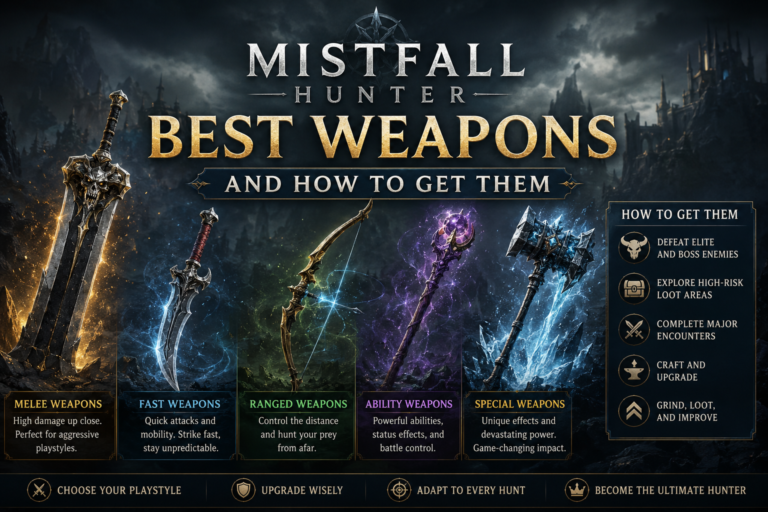
This Mistfall Hunter Weapons Guide explains the different weapon types, how they work, what kind of players they are best suited for, and how to choose the right weapon for your preferred build. Whether you are just starting your journey or experimenting with new combat styles, understanding your weapon options is one of the most important steps toward improving your performance.
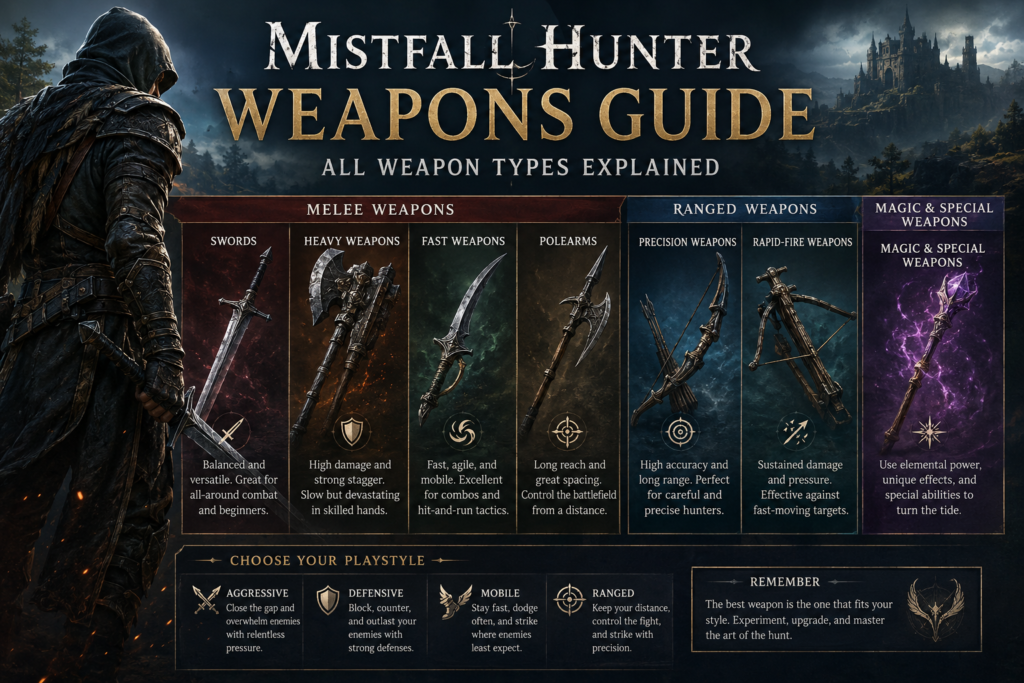
Your weapon is more than just a source of damage. It can influence your movement, defensive options, ability choices, combat range, stamina management, and even the types of encounters where your character performs best.
Table of Contents
- How Weapons Work in Mistfall Hunter
- Understanding Weapon Playstyles
- Melee Weapon Types
- Ranged Weapon Types
- Magic and Special Weapons
- How to Choose the Best Weapon
- Best Weapons for Beginners
- Weapon Strengths and Weaknesses
- Weapon Upgrades and Progression
- Mistfall Hunter Weapons FAQ
How Weapons Work in Mistfall Hunter
Weapons are at the center of your combat build in Mistfall Hunter. The weapon you choose determines much more than your basic attack. It can affect how quickly you move during combat, how much damage you can deal in a short period, how safely you can engage enemies, and which combat situations you are best prepared to handle.
A typical weapon choice can influence:
- Attack speed
- Damage output
- Attack range
- Area-of-effect potential
- Mobility
- Defensive capabilities
- Stamina or resource consumption
- Combo potential
- Crowd-control options
- Build synergy
This means that the weapon with the highest damage is not automatically the best choice. A slow, powerful weapon may dominate against heavily armored enemies but struggle when surrounded. A fast weapon may allow you to constantly pressure opponents but require more precise positioning and resource management.
The best weapon is usually the one that matches your preferred combat style and works well with the rest of your build.
Understanding Weapon Playstyles
Before choosing a weapon, it helps to understand the major combat styles available in the game.
Aggressive Playstyle
Aggressive players prefer to stay close to their targets and constantly deal damage. The best weapons for this style usually offer:
- Fast attacks
- Strong combo chains
- High sustained damage
- Quick recovery between attacks
- Good mobility
The downside is that aggressive players often need excellent positioning and timing to avoid taking unnecessary damage.
Defensive Playstyle
Defensive players focus more on blocking, spacing, counterattacking, and surviving difficult encounters.
These weapons often provide:
- Strong defensive options
- Reliable range
- Heavy stagger potential
- Powerful counterattacks
- High survivability
This playstyle can be slower, but it is often easier to control during difficult fights.
Mobile Playstyle
Mobility-focused builds rely on speed, repositioning, and avoiding attacks rather than absorbing damage.
Weapons suited to this style typically feature:
- Quick attack animations
- Fast movement
- Hit-and-run potential
- Strong dodge synergy
- Good single-target pressure
These builds can be extremely effective in the hands of experienced players.
Ranged Playstyle
Ranged weapons allow players to deal damage from a safer distance.
They can be particularly useful for:
- Engaging enemies before melee combat
- Attacking dangerous targets
- Maintaining spacing
- Supporting teammates
- Avoiding certain close-range attacks
However, ranged builds can become vulnerable when enemies successfully close the distance.
Melee Weapon Types Explained
Melee weapons are ideal for players who prefer direct combat. They usually require good positioning, timing, and knowledge of enemy attack patterns.
Swords
Swords are usually among the most balanced weapon options available. They typically offer a combination of moderate attack speed, reliable damage, good combo potential, flexible movement, and consistent range.
Because they do not focus entirely on one extreme strength, swords are often excellent for players who want a versatile combat style.
Strengths
- Balanced overall performance
- Easy to learn
- Useful in many different situations
- Good combination of offense and defense
- Reliable against both single targets and smaller groups
Weaknesses
- May not have the highest damage output
- Usually lack the extreme range of specialized weapons
- Can be outperformed in specific situations by more focused builds
Best for: Beginners, balanced builds, and players who want flexibility.
Heavy Weapons
Heavy weapons focus on powerful attacks and high-impact combat. These weapons are generally slower but can deliver devastating damage when attacks connect successfully.
Players using heavy weapons often need to think carefully about attack timing, enemy positioning, stamina management, recovery animations, and opportunities to punish enemies.
Strengths
- High damage per hit
- Strong stagger potential
- Excellent burst damage
- Powerful against durable targets
- Can punish mistakes heavily
Weaknesses
- Slower attack speed
- Longer recovery times
- Can leave players vulnerable
- Requires better timing
Best for: Players who prefer powerful attacks and deliberate combat.
Fast Weapons
Fast weapons focus on speed, mobility, and sustained pressure. Instead of relying on one massive hit, these weapons usually deal damage through multiple quick attacks.
A typical combat pattern may look like this:
- Move into range.
- Land several quick attacks.
- Dodge or reposition.
- Return before the enemy can recover.
Strengths
- Fast attacks
- Strong combo potential
- Excellent mobility
- High sustained damage
- Easier repositioning
Weaknesses
- Lower damage per individual hit
- May require more stamina management
- Often requires close positioning
- Can be risky against enemies with wide attacks
Best for: Mobile players and aggressive combat styles.
Polearms and Long-Reach Weapons
Long-reach weapons allow players to attack enemies from farther away than traditional melee weapons. Their main advantage is spacing.
These weapons can be particularly useful when fighting:
- Large enemies
- Groups
- Enemies with dangerous close-range attacks
- Targets that are easier to control from a distance
Strengths
- Excellent attack range
- Strong spacing potential
- Can control groups
- Safer than many close-range weapons
Weaknesses
- Can feel slower in tight combat
- May struggle against extremely mobile enemies
- Requires good positioning
Best for: Players who like controlling distance without committing to a fully ranged build.
Ranged Weapon Types Explained
Ranged weapons offer a completely different approach to combat. Instead of constantly fighting at close range, ranged players can focus on positioning, accuracy, and controlling the battlefield.
This section of our Mistfall Hunter Weapons Guide is especially useful for players who prefer safer engagements and tactical positioning.
Bows and Precision Weapons
Bows and similar precision-focused weapons reward careful aiming. A player using this type of weapon may focus on weak points, critical hits, maintaining distance, conserving resources, and attacking before enemies reach melee range.
Strengths
- Long-range damage
- Safe engagement distance
- High precision potential
- Excellent for opening fights
Weaknesses
- Requires accuracy
- Less effective when surrounded
- Can become vulnerable in close combat
Best for: Players who enjoy aiming, positioning, and careful target selection.
Rapid-Fire Ranged Weapons
Rapid-fire ranged options focus more on sustained damage than individual powerful shots. Instead of waiting for the perfect opportunity, players can apply continuous pressure.
Strengths
- Consistent damage
- Good pressure
- Useful against mobile targets
- Can maintain distance
Weaknesses
- Higher resource consumption
- Lower damage per shot
- May require constant repositioning
Best for: Players who prefer sustained ranged combat.
Magic and Special Weapons
Some weapons and combat tools may focus on magical, elemental, or ability-driven gameplay. Rather than relying entirely on traditional physical attacks, these weapons can provide additional tactical options.
Depending on the weapon and build, this may include:
- Area damage
- Elemental effects
- Damage-over-time effects
- Crowd control
- Defensive abilities
- Mobility skills
- Burst damage
Magic-oriented weapons often become stronger when combined with abilities and equipment that support the same damage type or combat strategy.
Strengths
- Unique combat effects
- Strong build synergy
- Potential crowd control
- Can provide powerful area damage
Weaknesses
- May depend heavily on resources
- Can require more complicated build planning
- Ability cooldowns may affect damage consistency
Best for: Players who enjoy experimenting with abilities and specialized builds.
How to Choose the Best Weapon in Mistfall Hunter
The best weapon depends on how you want to play. Instead of simply choosing the weapon with the highest damage number, consider the following factors.
1. Your Preferred Combat Range
Ask yourself where you feel most comfortable. Do you prefer fighting directly beside your target, maintaining medium distance, or attacking from long range?
2. Your Attack Speed Preference
Some players enjoy slow, powerful attacks, while others prefer landing multiple quick hits. Neither approach is automatically better. The important thing is choosing a weapon whose rhythm feels comfortable.
3. Your Defensive Style
Consider how you usually survive difficult encounters. You may prefer to block attacks, dodge constantly, stay at long range, use crowd control, or burst enemies before they become dangerous.
4. Your Build Synergy
Your weapon should work with your armor, skills, passive effects, upgrades, damage bonuses, and resource management.
Best Weapon Types for Beginners
New players should usually prioritize consistency over complexity. The easiest weapon type to learn is often one that provides a balance between damage, mobility, and survivability.
Look for weapons with:
- Straightforward attacks
- Manageable stamina usage
- Reliable range
- Good mobility
- Simple combos
- Few complicated mechanics
Balanced swords and other flexible weapon types are often a comfortable starting point because they allow players to learn enemy patterns without committing completely to a highly specialized playstyle.
Weapon Strengths and Weaknesses at a Glance
| Weapon Type | Damage | Speed | Range | Mobility | Difficulty |
|---|---|---|---|---|---|
| Swords | Medium | Medium | Medium | Medium | Easy |
| Heavy Weapons | Very High | Slow | Short to Medium | Low | Medium |
| Fast Weapons | Medium | Very Fast | Short | High | Medium |
| Polearms | Medium to High | Medium | Long | Medium | Medium |
| Precision Ranged Weapons | High | Slow to Medium | Very Long | Medium | Medium |
| Rapid-Fire Ranged Weapons | Medium | Fast | Long | High | Medium |
| Magic/Special Weapons | Varies | Varies | Varies | Varies | Advanced |
The exact performance of individual weapons can vary depending on their specific stats, upgrades, abilities, and the version of the game.
Weapon Upgrades and Progression
Finding a weapon you like is only the beginning. As you progress, pay attention to how weapon upgrades affect your build.
Base Damage
Increasing damage can improve your effectiveness against stronger enemies.
Attack Speed
Attack speed can be valuable for weapons that rely on sustained damage and combo chains.
Critical Damage
Critical-focused upgrades can reward precision and certain high-risk playstyles.
Elemental or Special Effects
Some weapons may benefit from effects that add:
- Fire damage
- Frost effects
- Poison or damage-over-time effects
- Lightning
- Other elemental bonuses
Resource Efficiency
If your weapon relies heavily on stamina, mana, ammunition, or another resource, improving efficiency can significantly improve your sustained combat performance.
Weapon Switching: When Should You Change Your Weapon?
Do not feel forced to use the same weapon throughout your entire journey. You may want to switch weapons when:
- You are struggling against a specific type of enemy.
- Your current weapon no longer matches your build.
- You find a weapon with stronger synergy.
- You want to try a different combat style.
- Your current weapon consumes too many resources.
- You need more range or mobility.
A flexible player who understands several weapon types can adapt more easily to different situations. That is one of the biggest advantages of learning the systems covered in this Mistfall Hunter Weapons Guide.
Common Weapon Mistakes to Avoid
Choosing Only Based on Damage
A weapon with higher damage may still be worse for your playstyle. Consider speed, range, safety, and build synergy.
Ignoring Attack Recovery
Slow weapons can be extremely powerful, but every missed attack can create an opening for the enemy. Learn when it is safe to commit.
Forgetting About Range
Players often underestimate how important attack range is. A small increase in effective range can make certain encounters significantly easier.
Overcommitting to Combos
Long combos can deal massive damage, but they can also leave you vulnerable. Learn when to stop attacking and reposition.
Ignoring Resource Management
A powerful weapon becomes much less effective if you constantly run out of stamina or other resources.
Mistfall Hunter Weapons FAQ
What is the best weapon in Mistfall Hunter?
There is no single best weapon for every player. The ideal choice depends on your build, preferred combat range, attack speed preference, and overall playstyle.
What weapon should beginners use?
Beginners should generally choose a balanced weapon with straightforward attacks, manageable resource usage, and reliable mobility.
Are heavy weapons better than fast weapons?
Not necessarily. Heavy weapons usually offer higher damage per hit, while fast weapons focus more on mobility and sustained damage.
Are ranged weapons easier to use?
Ranged weapons can be safer because they allow you to attack from a distance. However, they may require accuracy, resource management, and good positioning.
Should I upgrade every weapon I find?
It is usually more efficient to focus resources on weapons that fit your preferred build and playstyle rather than investing heavily in every weapon.
Can weapon choice affect my build?
Yes. Your weapon can influence your damage type, combat range, abilities, resource usage, and the upgrades that provide the best value.
Final Thoughts
Understanding weapon types is one of the most important parts of becoming a stronger player in Mistfall Hunter.
The right weapon can make combat feel smoother, safer, and more enjoyable. A weapon that perfectly matches your playstyle can also be more effective than a theoretically stronger option that feels awkward to use.
Use this Mistfall Hunter Weapons Guide as a starting point, experiment with different weapon categories, and pay attention to how each option changes your approach to combat.
If you enjoy aggressive close-range fights, fast weapons may be your best choice. If you prefer powerful attacks and staggering enemies, heavy weapons could be a better fit. Players who value spacing may prefer polearms, while ranged and magic-focused options can offer a more tactical approach.
As you unlock new equipment and refine your build, revisit your weapon choices regularly. The best weapon for your character can change as your skills, upgrades, and overall strategy evolve.
Ultimately, the best weapon is the one that gives you the strongest combination of damage, control, survivability, and enjoyment.
Related Guides
“`