Starting out in Mistfall Hunter can feel overwhelming. You are learning how weapons work, figuring out which stats matter, experimenting with abilities, and trying to survive encounters without losing valuable gear.
The good news is that beginners do not need complicated, high-risk builds.
The best beginner builds focus on four things:
- Survivability – staying alive long enough to learn encounters.
- Consistency – using weapons and abilities that work reliably.
- Low mechanical complexity – avoiding builds that require perfect timing or advanced combos.
- Easy progression – improving naturally as you find better gear.
This guide covers the best beginner-friendly builds in Mistfall Hunter, how to choose a starting playstyle, which stats to prioritize, how to build your loadout, and how to transition into stronger endgame setups.
Quick Answer: What Is the Best Beginner Build in Mistfall Hunter?
For most new players, the best build is usually a balanced survivability build built around:
- A reliable primary weapon
- Moderate defensive investment
- Consistent damage rather than risky burst damage
- Mobility or escape tools
- Healing or sustain options when available
- Gear that improves your main damage stat without sacrificing too much protection
The biggest mistake beginners make is trying to maximize damage immediately.
A powerful build is useless if you regularly lose fights before you can use it.
Instead, start with a build that allows you to survive mistakes. Once you understand enemy patterns, weapon ranges, ability timing, and extraction strategy, you can gradually shift toward more specialized high-damage builds.
How Builds Work in Mistfall Hunter
Before choosing a specific build, it helps to understand the basic idea behind build creation.
A good build is not simply a collection of the highest-level items you own. Your equipment, weapon choice, stats, abilities, and playstyle should all support the same goal.
For example, imagine you are creating a fast melee build.
You would generally want:
- A weapon that benefits from close-range aggression
- Stats that improve its damage or effectiveness
- Enough mobility to enter and leave fights
- Defensive options for surviving close-range encounters
- Abilities that help you stick to targets or escape danger
By contrast, a ranged or safer damage build may prioritize:
- Positioning
- Distance from enemies
- Consistent damage
- Stamina or resource management
- Escape options when opponents get close
The key principle is simple:
Your build should have a clear purpose.
Do not equip random items simply because they have higher numbers. A lower-level piece of equipment that supports your main strategy can sometimes be more useful than a stronger item that provides irrelevant bonuses.
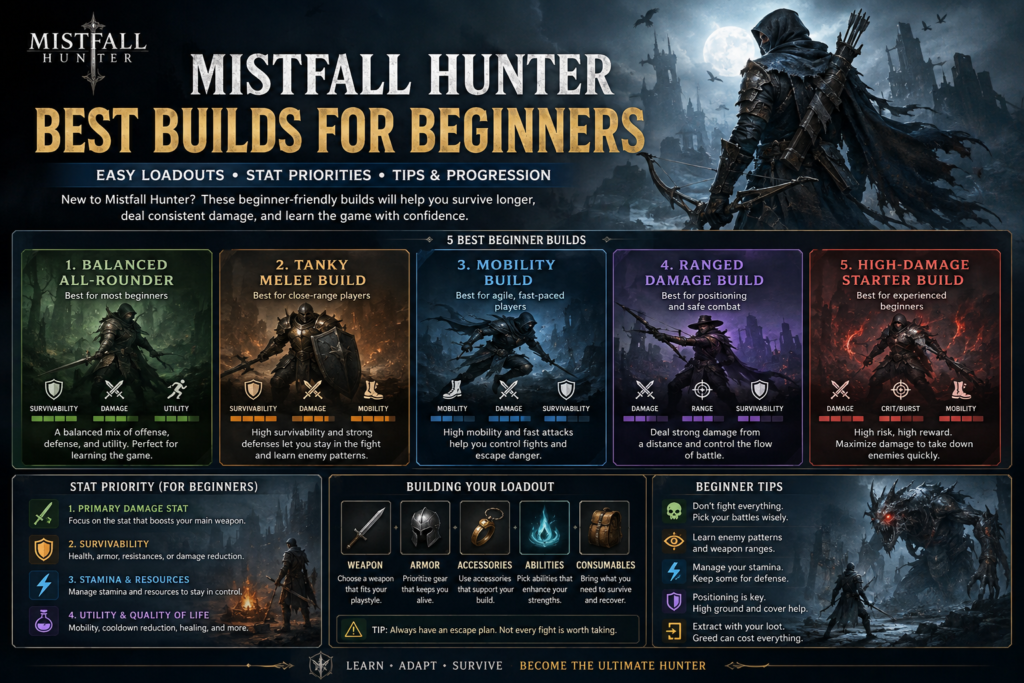
Best Beginner Build #1: Balanced All-Rounder
Best for: New players who are still learning the game
The balanced build is the safest recommendation for most Mistfall Hunter beginners.
Instead of specializing heavily in damage, defense, or mobility, this setup gives you a little of everything.
Build Priorities
- Main weapon damage
- Health and defensive stats
- Stamina or mobility
- Sustain and recovery
- Utility abilities
Why This Build Works
As a new player, you will make mistakes.
You may:
- Miss attacks
- Misjudge enemy range
- Get caught by an ability
- Engage too many enemies
- Run out of stamina
- Stay in a dangerous fight for too long
A balanced build gives you more room to recover from those mistakes.
Rather than trying to eliminate an opponent instantly, focus on surviving, dealing steady damage, and disengaging when the fight becomes unfavorable.
Recommended Playstyle
Use a simple combat pattern:
Engage → Deal Damage → Reposition → Recover → Re-engage
Do not feel pressured to finish every opponent immediately.
Sometimes the correct decision is to disengage, heal, reposition, and wait for a better opportunity.
Beginner Stat Priority
A good general priority is:
Main Damage Stat → Survivability → Mobility/Resource Management → Secondary Bonuses
This prevents the common beginner problem of investing heavily into several different stats without becoming particularly strong in any area.
Best Beginner Build #2: Tanky Melee Build
Best for: Players who enjoy close-range combat
If you prefer being in the middle of the action, a tankier melee setup is one of the most forgiving ways to learn Mistfall Hunter.
Close-range combat can be dangerous, especially when you are still learning enemy attacks and player abilities. Additional survivability gives you more opportunities to recover after making positioning mistakes.
Core Build Concept
Focus on:
- A reliable melee weapon
- Defensive gear
- Health or damage reduction
- Stamina management
- Close-range utility
- Consistent rather than overly complicated damage
Strengths
- Forgiving for new players
- Strong against basic encounters
- Allows you to learn enemy attack patterns at close range
- More room for mistakes
- Easier to maintain pressure during fights
Weaknesses
- Vulnerable to being kited
- Requires careful stamina management
- Can struggle if surrounded
- Heavy defensive investment may reduce your damage potential
How to Play It
- Approach carefully.
- Identify the most dangerous enemy.
- Engage when you have enough stamina and resources.
- Avoid unnecessary damage.
- Use defensive tools before your health becomes critical.
- Retreat when you lose control of the fight.
A tanky build does not make you invincible.
Think of your additional defenses as insurance against mistakes, not permission to ignore positioning.
Best Beginner Build #3: Fast Mobility Build
Best for: Players who prefer speed and aggressive repositioning
A mobility-focused build is ideal for players who dislike standing still.
This build emphasizes movement, positioning, and the ability to disengage quickly.
Instead of absorbing damage, you try to avoid it.
Core Priorities
- Movement or mobility bonuses
- Stamina efficiency
- Fast attacks
- Escape abilities
- Moderate damage
- Lightweight or flexible equipment where appropriate
Strengths
- Excellent for repositioning
- Easier to escape dangerous encounters
- Good for learning the map
- Can choose when to engage
- Strong against slower opponents
Weaknesses
- Less forgiving when caught
- Requires better awareness
- Can become resource-starved
- Poor positioning can quickly lead to defeat
Beginner Strategy
Do not use all of your mobility tools to start a fight.
This is one of the most common mistakes.
If you spend every dash, movement ability, or escape resource aggressively, you may have nothing left when the situation becomes dangerous.
Use some mobility to engage, but always keep enough mobility to escape.
Best Beginner Build #4: Safe Ranged Damage Build
Best for: Players who prefer positioning over direct combat
A ranged-focused build can be extremely comfortable for beginners because distance gives you more time to react.
Instead of constantly trading damage at close range, you can focus on:
- Positioning
- Target selection
- Timing
- Resource management
- Maintaining distance
Core Priorities
- Ranged damage
- Accuracy or consistency
- Positioning tools
- Escape abilities
- Resource efficiency
- Enough survivability to survive unexpected pressure
Strengths
- Safer against predictable enemies
- Gives you more time to react
- Allows you to contribute damage from favorable positions
- Excellent for learning encounter patterns
Weaknesses
- Vulnerable when opponents close the distance
- Requires awareness of your surroundings
- May depend heavily on resources
- Positioning mistakes can be difficult to recover from
Best Beginner Build #5: High-Damage Starter Build
Best for: Players who already understand the basics and want faster kills
Once you become comfortable with movement and combat, you can start experimenting with more aggressive damage builds.
This type of build sacrifices some survivability in exchange for stronger offensive potential.
Core Priorities
- Primary damage stat
- Weapon scaling
- Critical or burst potential, where relevant
- Offensive abilities
- Enough mobility to reposition
- Minimum survivability requirements
Important Warning
This is not the best build for every new player.
A glass-cannon setup can feel powerful when everything goes well, but it can also be expensive if you regularly lose valuable equipment.
Before switching to a high-damage build, ask yourself:
- Can I consistently avoid enemy attacks?
- Do I understand when to disengage?
- Can I manage my resources?
- Do I know my weapon’s effective range?
- Am I comfortable losing this gear?
How to Choose the Right Weapon for Your Build
Your weapon should be the center of your build.
Everything else should support the way that weapon performs.
1. Range
Ask yourself how close you need to be to deal damage.
Short-range weapons may offer strong pressure but expose you to more danger.
Longer-range weapons can provide safety but may struggle when enemies close the gap.
Choose a range that matches your natural playstyle.
2. Attack Speed
Fast weapons are often more forgiving because missed attacks may not leave you vulnerable for as long.
Slower weapons can deliver powerful hits but may require better timing.
As a beginner, consistency is often more valuable than theoretical maximum damage.
3. Resource Consumption
Pay attention to how much stamina, ammunition, mana, energy, or other resources your weapon requires.
A powerful weapon is less useful if you constantly run out of the resource needed to use it.
4. Difficulty
Some weapons are naturally easier to use.
A beginner-friendly weapon usually has:
- Clear attack patterns
- Reliable damage
- Reasonable range
- Simple combos
- Manageable resource requirements
5. Scaling
Look for stats and equipment bonuses that directly improve your chosen weapon.
If your weapon benefits primarily from one offensive stat, prioritize that stat instead of spreading your investment across unrelated bonuses.
The Best Stat Priority for Beginners
Priority 1: Your Primary Damage Stat
Choose the main stat that supports your weapon or preferred damage source.
This should usually be the foundation of your offensive investment.
Priority 2: Survivability
Your second priority should generally be staying alive.
Depending on your available options, this may include:
- Maximum health
- Armor
- Damage reduction
- Resistance
- Shields
- Defensive passives
- Healing effectiveness
Priority 3: Stamina and Resource Management
Resource management is frequently underestimated.
Running out of stamina at the wrong moment can prevent you from:
- Dodging
- Escaping
- Attacking
- Blocking
- Repositioning
Priority 4: Utility
Utility bonuses can be extremely valuable even when they do not directly increase your damage.
Examples include improvements to:
- Movement
- Cooldown reduction
- Carry capacity
- Healing
- Recovery
- Detection
- Escape potential
A Simple Beginner Build Formula
Step 1: Choose One Primary Playstyle
- Tanky melee
- Balanced melee
- Mobility
- Ranged damage
- High damage
Step 2: Choose One Primary Damage Source
Your build should have a clear answer to this question:
How do I expect to win fights?
Step 3: Add Enough Survivability
Even aggressive builds need a survival plan.
Ask:
What happens if my first attack fails?
Step 4: Add an Escape Option
One of the best upgrades a beginner can make is having a reliable way to disengage.
Not every encounter is worth winning.
Recommended Beginner Gear Strategy
Budget Loadout
Use this for:
- Learning new areas
- Testing weapons
- Farming
- Practicing combat
- Exploring dangerous mechanics
The goal is to minimize the cost of failure.
Standard Loadout
This should be your normal setup.
Use gear that gives you a meaningful advantage without risking equipment that would be difficult to replace.
High-Value Loadout
Reserve your best equipment for situations where you understand the risk and have a specific reason to use it.
Before bringing expensive gear, ask:
Can I afford to lose this?
Best Beginner Skills and Abilities
When selecting skills or abilities, beginners should prioritize reliability.
Mobility
Movement abilities can help you:
- Avoid attacks
- Escape dangerous situations
- Reach favorable positions
- Close the distance when necessary
Defense
Useful defensive effects may include:
- Shields
- Damage reduction
- Temporary protection
- Crowd control resistance
- Enemy disruption
Sustain
Healing and recovery abilities can significantly increase the value of a beginner build.
Crowd Control
Abilities that interrupt, slow, stun, knock back, or otherwise disrupt enemies can provide valuable breathing room.
Beginner Combat Tips That Will Improve Any Build
Do Not Fight Every Enemy You See
Some fights offer very little reward compared to their risk.
Before engaging, consider:
- What can I gain?
- What can I lose?
- Do I have enough resources?
- Do I have an escape route?
- Could another enemy join the fight?
Learn Your Weapon Range
Spend time understanding exactly where your attacks connect.
Manage Your Stamina
Avoid using all of your stamina simply to deal damage.
If possible, always keep enough for a defensive reaction or escape.
Stop Chasing Every Kill
A low-health opponent can be tempting, but chasing too aggressively can lead you into traps or unfavorable positions.
Extract or Leave Before Greed Becomes a Problem
One of the biggest beginner mistakes in extraction-style gameplay is staying too long.
Set a goal before entering. When you achieve it, seriously consider leaving.
Common Beginner Build Mistakes
Mistake #1: Copying an Endgame Build Immediately
Experienced players may use highly optimized builds that require rare gear, advanced mechanics, excellent timing, and extensive game knowledge.
Build for your current skill level.
Mistake #2: Using Expensive Gear Too Early
Start with affordable gear and upgrade gradually.
Mistake #3: Ignoring Defensive Stats
More damage is always attractive, but surviving longer gives you more opportunities to deal damage.
Mistake #4: Spreading Stats Too Thin
Choose a primary strategy and support it.
Mistake #5: Having No Escape Plan
Every build should answer this question:
How do I get out when the fight goes badly?
Beginner Build Progression: Early Game to Advanced Play
Stage 1: Learning
- Affordable equipment
- Simple weapons
- Survivability
- Learning maps and encounters
- Understanding combat mechanics
Stage 2: Specialization
Once you understand your preferred playstyle, begin investing more heavily into a specific strategy.
Stage 3: Optimization
After gaining experience, you can experiment with:
- High-value gear
- Advanced stat combinations
- Specialized abilities
- High-risk, high-reward builds
- Meta strategies
Sample Beginner Loadout Template
Weapon
Choose one weapon you can use consistently.
Primary Stats
Invest primarily in the stats that improve your main damage source.
Defensive Stats
Add enough health, armor, resistance, or protection to survive mistakes.
Mobility
Include at least one reliable way to reposition or escape.
Sustain
Bring healing or recovery options appropriate for your activity.
Utility
Choose bonuses that improve consistency, such as resource efficiency, cooldown management, or movement.
Economy
Use gear you can realistically afford to lose.
Which Beginner Build Should You Choose?
| Build | Difficulty | Survivability | Damage Potential | Mobility | Best For |
|---|---|---|---|---|---|
| Balanced All-Rounder | Easy | High | Medium | Medium | Most beginners |
| Tanky Melee | Easy–Medium | Very High | Medium | Low–Medium | Close-range players |
| Mobility Build | Medium | Medium | Medium | High | Fast, evasive players |
| Safe Ranged Build | Easy–Medium | Medium | Medium–High | Medium | Positioning-focused players |
| High-Damage Build | Harder | Low–Medium | Very High | Medium | Experienced beginners |
For most players, the Balanced All-Rounder is the best starting point.
It teaches the fundamentals without heavily punishing every mistake.
Frequently Asked Questions
What is the easiest build for beginners in Mistfall Hunter?
A balanced build with reliable damage, moderate defenses, and a mobility or escape option is usually the easiest starting point.
Should beginners prioritize damage or defense?
Start with a balance. Your primary damage stat should support your chosen weapon, but do not sacrifice all survivability for damage.
Should I use expensive gear as a beginner?
Only if you are comfortable losing it. Affordable and replaceable gear is often better for learning because it allows you to experiment without excessive risk.
What is the most important skill for beginners?
Game knowledge. Understanding positioning, weapon range, stamina management, enemy behavior, and when to disengage will often improve your results more than a small increase in gear quality.
When should I switch to a more advanced build?
Consider specializing when you understand your preferred playstyle and can consistently survive encounters with your current setup.
Final Thoughts
The best Mistfall Hunter build for beginners is not necessarily the build with the highest damage or the rarest equipment.
It is the build that helps you learn, survive, and progress consistently.
Start with a reliable weapon. Focus your stats instead of spreading them everywhere. Invest enough in survivability to recover from mistakes. Always have a plan for escaping a bad fight.
As you gain experience, you can gradually transition from a balanced beginner setup into a specialized melee, ranged, mobility, defensive, or high-damage build.
A good beginner build should be easy to use, affordable to replace, and forgiving enough to let you learn from mistakes.
Master the fundamentals first. The stronger builds will make much more sense once you understand how you want to play Mistfall Hunter.
Recommended Next Guides
- Mistfall Hunter Beginner’s Guide: Everything You Need to Know
- Mistfall Hunter Best Weapons Ranked
- Mistfall Hunter Best Classes for Solo Players
- Mistfall Hunter Best Skills and Abilities
- Mistfall Hunter Tips and Tricks for Beginners
- Mistfall Hunter Best Solo Build